
How people play
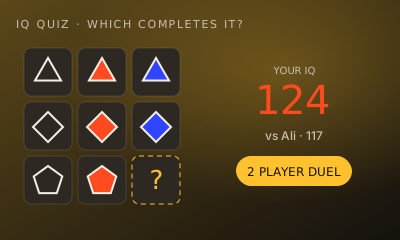
Friends share a room code and answer the same question at the same time, families pass one phone around with Local vs, and solo players warm up against the computer. Questions go from easy to hard across the game and mix pattern matrices, number series, logic, spatial, verbal, maths and general knowledge.
Common challenges
- Seeing too many rules at onceMatrices usually change one or two properties per row. Check shape, count, shading and direction one at a time.
- Stopping at the first gapNumber series often hide a second layer: gaps that grow, alternate terms, or squares and primes.
- Rotation vs mirrorA mirror image can never be produced by turning a shape. Look for the asymmetric notch and follow it round.
- Rushing hard questionsSpeed only trims up to 15% from a right answer, while a wrong one scores nothing.
What strong play proves
A high score shows quick pattern spotting, comfortable mental arithmetic and a calm head under a timer. It is a fun estimate, not a clinical IQ test.
What it improves
- Pattern recognitionWins come from spotting shapes, threats, and repeats early.
- Mental mathTotals, odds, and distances get calculated on the fly.
- Verbal fluencyWords, letters, and prompts reward quick language access.
- Decision speedGood enough now beats perfect too late.
Best for
Friendly rivalries between classmates, colleagues or siblings, puzzle fans who like a short brain workout, and anyone curious how they do on IQ-style questions.